AI is quickly becoming a given in construction, whether your company is using it yet or not. Construction owners and decision makers are being asked the same question right now: which AI tool should we use? It’s a reasonable question, but there’s another one that matters just as much. Before choosing a tool, you have to decide where that tool will get its data and what it will be allowed to touch.
I spent years as a construction CFO, where protecting the integrity of the company’s financial data was a core part of the job. Today, as a construction consultant, I spend my work life focused on what matters most to modern construction companies, and few decisions matter more right now than how AI fits into the business without putting their data at risk.
In the AI-centric world in which we live, data has become one of the most valuable assets a company owns. AI tools are only as useful as the data they can reach, which means your job costs, billing history, WIP, and customer records now carry value well beyond your own reporting. Software vendors and AI providers understand this. Many increasingly treat access to customer data as a form of currency: something to control, charge for, or use to keep customers on their platforms. For a construction company, that changes the stakes. Your financial data isn’t just a record of how the business performed. It’s leverage, and whoever controls it has a say in how and where your company can use AI going forward.
That’s why the path your data takes matters as much as the tool you choose. There are several common ways to connect AI to your financial data, each with real trade-offs. Before walking through them, it helps to define two terms.
Key Takeaways
- The data path matters as much as the tool. Before choosing an AI tool, decide where it gets its data and what it is allowed to touch.
- Financial data is leverage. Job costs, billing history, WIP, and customer records carry value well beyond reporting, and vendors treat access to them as currency.
- There are four common ways to connect AI. Manual exports, third-party AI platforms, middleware, and a data warehouse run from simplest to most controlled.
- A data warehouse best protects your data. AI reads from a governed copy your company owns, never touches the system you close the books in, and stays with you through tool changes.
- No architecture fixes bad data. A warehouse still needs access controls, and it gives you one place to find and correct coding problems at the source.

What is a data warehouse, and what is a source of truth system?
Your source of truth system is the system where a given type of data is officially recorded and maintained. For financial data, that’s your ERP or accounting system, whichever system your team closes the books in. For some project data, such as schedules, RFIs, submittals, or daily logs, it may be your project management system. Either way, these are transactional systems. They record what happened today: an invoice approved, a change order entered, a cost coded to a job, a daily report filed. They’re built to write and update records quickly and accurately. They aren’t built to answer questions about the last three years.
A data warehouse is a centralized storage system designed to collect, integrate, and manage data from multiple sources to support reporting and analysis. It’s defined by four core traits:
Subject-oriented: Data is organized around business areas, such as jobs, customers, or cost codes, rather than around individual software applications.
Integrated: Data from different systems is combined and standardized into a single consistent view. Your ERP and your project management system finally agree on what each job is.
Time-variant: History is kept over months or years, so you can analyze trends and build forecasts. Last March’s WIP stays last March’s WIP.
Nonvolatile: Once data is stored, it isn’t changed or deleted by day-to-day transactions, so the historical record stays consistent.
In short, a data warehouse is a separate copy of your business data, built for analysis and kept apart from the system you run the business in. In this article, I use the term broadly, to include related approaches like data lakes, lakehouses, and data marts, in case you’ve heard of those terms as well.
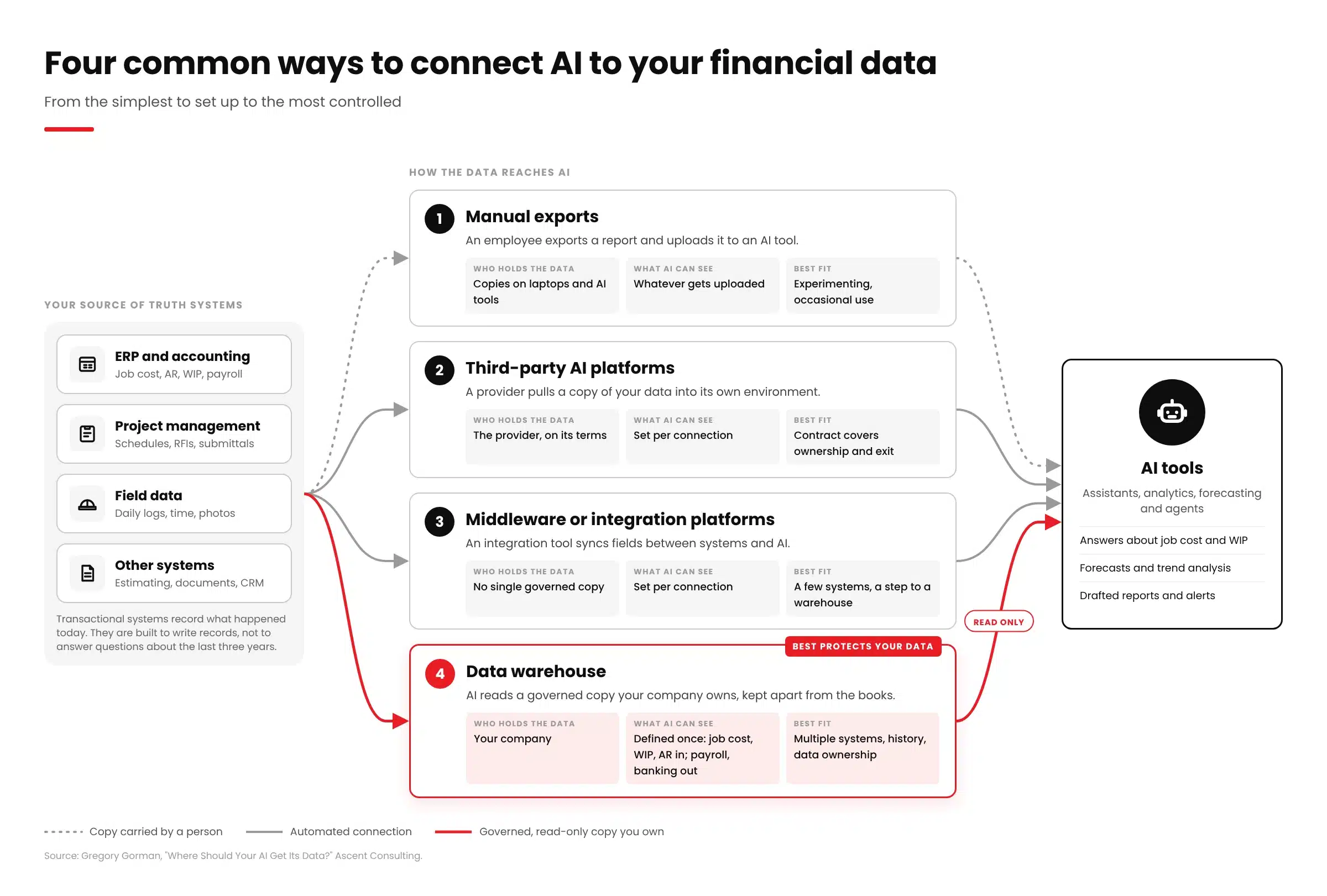
With those two definitions in place, the real question becomes how AI reaches your data. In many construction companies, there isn’t just one answer. Depending on how your systems and teams are set up, data may already be reaching AI in several ways at once, through different tools, departments, employees, and vendors. Each path determines what AI can see, what it can change, and who ultimately controls the information your business runs on. There’s no single right answer for every company, so it helps to understand the most common options side by side. The four below run roughly from the simplest to set up to the most controlled.
Four Common Ways to Connect AI to Your Financial Data
1. Manual Exports
With manual exports, someone on your team pulls a report or spreadsheet and uploads it to an AI tool as needed. It’s the simplest and least expensive approach, requires no integration, and lets you decide exactly what gets shared each time. The trade-off is consistency and oversight. The data is only as current as the last export, every analysis starts from scratch, and without a clear policy, employees may upload sensitive information like payroll or customer data to tools the company never approved. It tends to fit best when you’re experimenting with AI, the analysis is occasional, and you’ve set clear rules on which tools and data are allowed.
2. Third-Party AI Platforms
With a third-party platform, an outside AI or analytics provider connects to your systems and pulls a copy of your data into its own environment. These platforms often connect to several systems at once and deliver dashboards, forecasting, or AI features quickly. The trade-off is ownership of the copy. Your data now lives under someone else’s terms, which govern how long it’s kept, whether it can train their models, how easily you can export it, and what happens if you leave. Those terms can change, too. This approach tends to fit best when the contract clearly states that you own your data, that it won’t be used for model training, that you can export all of it, and that it will be deleted when you leave.
3. Middleware or Integration Platforms
With middleware, a separate integration tool syncs data between your systems and your AI tools, either on a schedule or in near real time, without a full warehouse. It can link several systems, filter which fields are passed along, and enforce read-only access, often with less up-front work than a warehouse. The trade-off is consistency and history. Middleware usually moves data rather than keeping it, definitions can still differ between systems, and an AI tool receiving raw fields doesn’t automatically know how your company defines committed cost, earned revenue, or a fade. It also adds another vendor and more connections to maintain. It tends to fit best when you need a few systems connected for specific purposes, or as a step toward a warehouse later.
4. Data Warehouse
With a data warehouse, AI reads from a governed copy of your data that your company owns and controls. You decide what goes in, so job cost, WIP, and AR can be included while payroll detail and banking information stay out. AI works against a copy rather than your live accounting system, so it can’t change the records your business runs on. A warehouse also combines data from multiple systems, preserves history for trend analysis, and stays with you if you change AI providers or replace your ERP. The trade-off is time, cost, and upkeep. A warehouse must be designed, loaded, and maintained, data is typically refreshed on a schedule rather than in real time, and for a smaller company with simple needs, it may be more than the problem requires. It tends to fit best when you want AI working across multiple systems, need history, want sensitive data kept out of AI’s reach, or care about long-term data ownership, for example ahead of a sale or outside investment.
Who holds the keys to your company's data?
Most construction companies already have data reaching AI in more than one way. Ascent maps every path your financial data takes today, from exports to vendor platforms, and designs the warehouse or integration that keeps it under your control.
Which approach best protects your data?
Each of these approaches has a place, and many companies will use more than one. But if the question is which one best protects your company’s data, the answer is the data warehouse.
The reason comes down to four security questions that apply to any AI connection.
Who holds the data? With manual exports, copies end up scattered across individual laptops and AI tools. With third-party platforms, a copy lives in the provider’s environment under their terms. Middleware passes data along but doesn’t give you one governed place to hold it. A warehouse keeps the copy in an environment your company owns and controls.
What can AI see? With exports, that depends on what each employee decides to upload. With third-party platforms and middleware, it depends on how each connection is configured. A warehouse lets you define once what AI can access, such as job cost, WIP, and AR, and keep sensitive data like payroll detail and banking information out entirely.
Can AI change your source data? Not when a warehouse is in place. The warehouse sits between your AI tools and your accounting system, so AI only ever reads from a copy of your data and never touches your software systems.
Can you see and control access over time? A warehouse gives you one place to manage permissions, monitor who and what is reading the data, and cut off an AI provider without losing your history or rebuilding your data. The other approaches spread that responsibility across employees, vendors, and connections.
This doesn’t make a warehouse secure by default. Because it brings your data together in one place, it needs its own protections: role-based access, encryption, and regular review of who has access. And no architecture fixes bad data. If costs are coded wrong in your ERP, AI will simply report the wrong answer faster.
However, a data warehouse makes both of those problems easier to solve. Because your data sits in one place, security protections can be applied once and applied consistently, rather than managed separately across every tool, employee, and vendor connection. And because data from different systems is brought together and standardized, inconsistencies that were hidden before start to surface: a job coded one way in your ERP and another way in your project management system, or costs that don’t match between systems. A warehouse won’t fix bad data on its own, but it gives you one place to find it, flag it, and correct it at the source, so the answers AI gives you get better over time.
AI tools will surely continue to change. New platforms will appear, and the tool that seems like the right choice today may not be the right one in three years. Your data is different. It’s the one asset that stays with your company through every one of those changes, and in a world where data is treated like currency, it’s worth protecting like currency. When it comes to keeping control of your data as AI becomes part of the business, a warehouse puts that control where it belongs: with you. So before you decide which AI tool to use, decide where your data will live and who will hold the keys. If you want to know where your data is reaching AI today, schedule a free consultation.
Frequently asked questions
1. How do construction companies connect AI to their financial data?
Most use one or more of four paths: manual exports uploaded to an AI tool, third-party AI platforms that copy data into their own environment, middleware that syncs data between systems, or a data warehouse that holds a governed copy the company owns. Many companies already use several at once, through different tools, departments, and vendors.
2. What is a data warehouse in construction?
A data warehouse is a separate copy of your business data built for analysis. It combines data from your ERP, project management, and other systems into one consistent view organized by jobs, customers, and cost codes, keeps history over months or years, and isn’t changed by day-to-day transactions, so AI can analyze it without touching live records.
3. What strategies can construction companies use to improve data quality for AI?
Start at the source: consistent cost coding in the ERP, job definitions that match between accounting and project management, and a clean close. Bringing data together in a warehouse helps, because mismatches between systems surface in one place, where they can be flagged and corrected at the source instead of being repeated faster by AI.
4. How can construction firms ensure they have clean historical data for AI?
Keep history in a system built for it. Transactional systems like an ERP record what happened today; a data warehouse keeps last March’s WIP as last March’s WIP, so trends and forecasts rest on a consistent record. Fix coding errors where they start, because AI will simply report the wrong answer faster.
5. How are construction companies addressing data security when using AI platforms?
By deciding what AI can see before connecting it. A governed copy lets a company include job cost, WIP, and AR while keeping payroll detail and banking information out, apply role-based access and encryption in one place, monitor who is reading the data, and cut off an AI provider without losing its history.
6. What should an AI vendor contract say about your company's data?
It should state that you own your data, that it won’t be used to train the vendor’s models, that you can export all of it, and that it will be deleted when you leave. Without those terms, a copy of your financial data lives in someone else’s environment under rules that can change.
Services Mentioned in This Article
- Construction AI Consulting: operations-first AI strategy and implementation for construction companies.
- Construction Software & Technology: software selection, implementation, and integration across ERP and project systems.
- ERP Post-Implementation Advisory: getting reliable, well-coded data out of the ERP you already have.
Related Reading
- How Can Construction Companies Start Using AI to Create Real Business Value
- How to Capture Tribal Knowledge With Construction AI
- System Implementation Vs. System Integration
- Beyond the Basics: The Strategic Use of Cost Codes and Cost Types
About the Author
Gregory Gorman, MBA, is a Senior Consultant and Principal at Ascent Consulting. A former construction CFO, Greg has 20+ years of financial, operational, and leadership experience focused on construction, development, and construction management. He now works with contractors as a consultant and fractional CFO.
About Ascent Consulting
Ascent Consulting is a construction-business consulting firm that is software-agnostic and operations-first. We work inside general contractors, specialty trade contractors, and private equity-backed construction companies, and our consultants have run the accounting, operations, and project teams we now advise. From ERP selection and integration to AI strategy and fractional CFO leadership, our work starts with the same question this article asks: who controls the data your business runs on? Talk to our team.