PMO: Project Management Office for Construction
Make Technology Change Work for the Business. Not the Other Way Around.
Implementing a new ERP, consolidating multiple systems, integrating Procore with the rest of your technology stack, or standardizing technology across multiple companies is not simply a software project. It is a business transformation project.
The software vendor knows its software. The VAR knows how to configure the ERP. Your integration partner knows how to build the connection. Your internal team knows your business. But who is responsible for making sure all of it works together? That is the role of Ascent’s Project Management Office.
We provide the program leadership, construction technology expertise, governance, and execution discipline required to guide complex technology change from plan through successful adoption. We manage the vendors, coordinate your internal teams, drive decisions, track dependencies, manage risk, and keep the entire program moving toward the business outcomes you set at the beginning.
Your people already have full-time jobs. They should not also have to become experts in managing software companies, ERP implementations, data migrations, integrations, and organizational change. That is what we do.

Sound Familiar?
Why Construction Technology Implementations Go Sideways
Nobody owns the entire outcome
The ERP implementer is responsible for the ERP. Procore is responsible for Procore. Your payroll provider is responsible for payroll. Your middleware developer is responsible for the integration.
Each party can successfully deliver its individual scope while the overall implementation still fails.
Ascent sits above the individual workstreams and manages the program as a whole. We make sure decisions in one system do not create problems somewhere else and that everyone is working toward the same operating model and business outcomes.
Your internal team doesn't have the capacity to manage it
Your CFO, controller, operations leaders, project executives, IT team, and subject matter experts still have businesses to run.
A major technology implementation may require hundreds or thousands of hours of internal participation, decision-making, testing, training, data preparation, and validation. Without dedicated program leadership, the work gets pushed onto already-busy employees and critical decisions begin competing with their day jobs.
PMO creates the structure, accountability, and outside capacity to keep the project moving without requiring one of your executives to become the full-time implementation manager.
Your team shouldn't have to become software implementation experts
Most construction executives may go through a major ERP implementation only once or twice in their careers.
We do this repeatedly. Ascent understands construction operations, project accounting, ERP systems, Procore, integrations, data migration, permissions, workflows, and the practical realities of implementing new technology inside an operating construction company. We know the questions to ask, the problems to anticipate, and the decisions that have to be made before they become emergencies.
The vendor's definition of success isn't necessarily yours
A software company’s primary objective is understandably to implement its software.
That doesn’t automatically mean your estimating, project management, accounting, payroll, procurement, field operations, and executive reporting processes will work the way you expect when the project is finished.
Ascent does not sell software and we are not paid by the software companies. We represent you. We start with the business outcomes you are trying to achieve and manage the implementation around those outcomes—not around the vendor’s preferred configuration or go-live schedule.
The systems work individually, but not together
Your ERP may handle accounting and job cost. Procore may manage project execution. Payroll, CRM, estimating, procurement, telematics, or other systems may sit around them.
The question is not whether each application works. The question is whether the technology ecosystem works together.
PMO manages workflows, integrations, data ownership, system dependencies, and validation across platforms so your technology stack operates as one connected business system.
Nobody is managing the sequence of decisions
Technology implementations contain hundreds of dependencies.
Cost structure affects configuration. Configuration affects integrations. Integrations affect workflows. Workflows affect permissions. Permissions affect training. Data structure affects reporting. Reporting requirements may change decisions made months earlier.
Doing the right work in the wrong order can create months of rework. Ascent manages the integrated implementation plan, dependencies, decision points, and stage gates so the project progresses in a deliberate sequence and only advances when the business is ready.
Your existing processes aren't ready to be automated
New software will not fix a poorly defined process. It will usually automate it.
Before technology is configured, Ascent helps evaluate the underlying business processes, roles, cost structures, workflows, master data, and decision rights that the system needs to support. That may include cost codes, chart of accounts, vendor and customer structures, job numbering, approval workflows, organizational roles, access, and responsibilities.
The goal is not simply to reproduce your current system in new software. The goal is to build a better operating environment.
What is a PMO?
Project Management Office (PMO) ensures that you have a dedicated firm managing technology change so it doesn’t fall on your shoulders.
PMO consultants may be doing a lot of the heavy lifting while running point on an ERP migration end-to-end, from evaluation through selection, implementation, and training. Or, a PMO could be simply managing multiple parties and getting them all to play nicely. Either way, PMO means program management and change management support for your construction technology stack, wherever you need it.
Sometimes we perform a significant amount of the work ourselves. In other situations, specialist vendors perform most of the technical work while Ascent manages the overall program.
Depending on the engagement, Ascent may oversee:
-
ERP implementation or migration
-
Procore implementation or optimization
-
Multiple-system integration
-
Custom middleware development
-
Technology stack consolidation
-
Multi-company or multi-entity standardization
-
Private-equity platform standardization
-
Data migration and system consolidation
-
Digital transformation initiatives
PMO CONSULTING
What Ascent's PMO Does
Program Leadership & Governance
We establish the management structure required to run the project effectively. That includes defining who makes which decisions, how issues are escalated, how stakeholders participate, and how leadership maintains visibility into progress.
Rather than allowing decisions to disappear into email threads and individual vendor meetings, we create a disciplined governance structure around the program.
Vendor & VAR Management
Software companies and implementation partners each manage their own scope. Ascent manages the space between them.
We coordinate software vendors, VARs, developers, data specialists, integration partners, and other third parties while holding each party accountable to the overall implementation plan. When something falls between scopes, the question doesn’t become, “Whose problem is this?” We help get it resolved.
Stakeholder Alignment & Change Management
Successful implementation requires more than configuration. People need to understand:
- What is changing
- Why it is changing
- How it affects their role
- When they become involved
- What decisions they own
- What they need to learn
- What will be expected after go-live
We help establish the communication cadence, stakeholder groups, departmental workstreams, training strategy, policies, procedures, and internal ownership required to build adoption. The more visibility people have into the change, the less resistance the organization encounters when it arrives.
Risk, Issue & Dependency Management
Complex implementations will encounter problems. Good PMO management ensures those problems become managed decisions rather than surprises.
We maintain visibility into risks, issues, dependencies, outstanding decisions, and potential schedule impacts and bring those items to the appropriate stakeholders early enough to act.
Our role is often to say: “Here is the issue. Here are your options. Here are the implications of each. Now we can make an informed decision and keep moving.”
Readiness, Cutover & Stabilization
Going live is not the finish line. Before cutover, we help evaluate whether the organization, data, integrations, processes, permissions, and users are actually ready. If a critical requirement has not been met, the program should not advance simply because a date was placed on a calendar months earlier.
After go-live, we remain involved through stabilization and operational validation to make sure the systems work in the real world—not just in the implementation environment.
Software companies and implementation partners each manage their own scope. Ascent manages the space between them.
We coordinate software vendors, VARs, developers, data specialists, integration partners, and other third parties while holding each party accountable to the overall implementation plan. When something falls between scopes, the question doesn’t become, “Whose problem is this?” We help get it resolved.
Integrated Project Planning & Sequencing
We develop and manage the overall implementation roadmap across vendors, systems, internal workstreams, and business dependencies. That includes:
- Integrated project schedule
- Major phases and milestones
- Dependencies
- Critical decisions
- Resource requirements
- Stage gates
- Go/no-go criteria
- Cutover planning
- Stabilization activities
The objective is not simply to keep a schedule updated. It is to make sure the project is moving in the right sequence at the right speed for the business.
Integration & Technology Ecosystem Management
Software companies and implementation partners each manage their own scope. Ascent manages the space between them.
We coordinate software vendors, VARs, developers, data specialists, integration partners, and other third parties while holding each party accountable to the overall implementation plan. When something falls between scopes, the question doesn’t become, “Whose problem is this?” We help get it resolved.
Business Process & Workflow Design
Technology should support the way your business needs to operate.
We work across accounting, project management, operations, estimating, procurement, payroll, IT, and leadership to understand how work needs to flow across the organization. We then help translate those requirements into workflows, configuration decisions, system ownership, and integration requirements.
Data Strategy & Migration Oversight
Moving data is one of the most underestimated parts of a technology change. We help determine:
- What data needs to migrate
- How much historical information is required
- What data needs to be cleaned first
- How master records should be standardized
- Which system owns each data set
- How active projects will transition
- How data will be validated
- What historical information should remain accessible
The objective is not merely to move data. It is to make sure the new environment starts with usable, reliable information.
Construction-Born Consultants
A Different Kind of Technology Consultant
Construction Experience Matters
We are not generalist IT consultants learning construction terminology during your implementation. Ascent has spent more than a decade working exclusively with construction companies on operations, project management, accounting, technology, and organizational performance.
We understand how information moves from estimating into operations, from the field into project management, from project management into accounting, and ultimately into the financial and operational reporting leadership relies on to run the company. That perspective matters when technology touches every one of those functions.
You Get a Team, Not Just a PM
Technology transformations frequently cross multiple areas of expertise.
A typical Ascent PMO engagement may include a lead program consultant supported by construction operations, ERP, Procore, finance, data, integration, or other subject matter experts depending on the needs of the project. That gives the project access to the right expertise at the right point rather than expecting one project manager to know everything.
We Are Independent
We do not sell ERP systems. We do not receive commissions from software companies. We are not incentivized to recommend a particular platform or force an implementation through a vendor’s standard methodology.
Our client is the contractor. Our job is to help you achieve the business outcome you hired the technology to produce.
References
PMO Consulting At Work
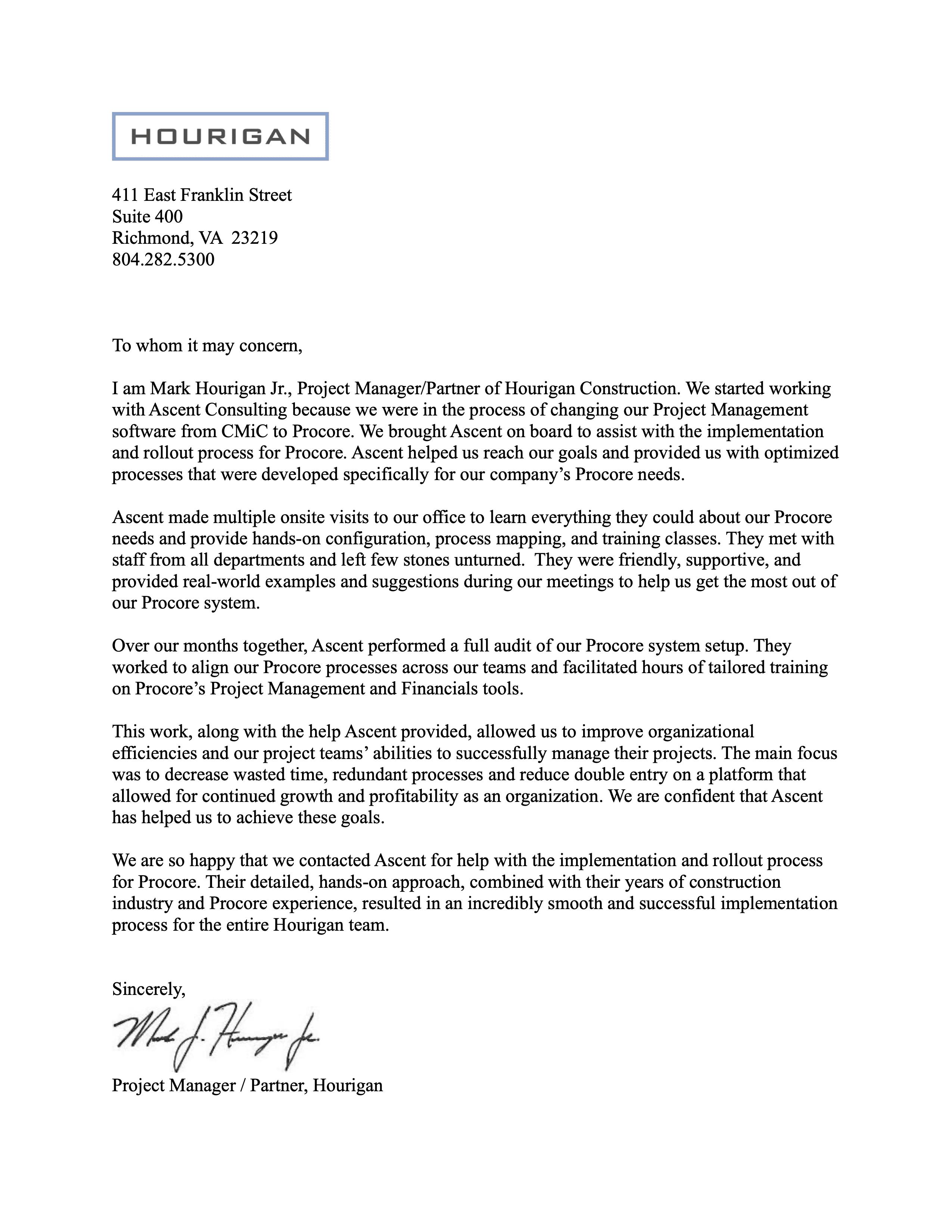
“Their detailed, hands-on approach, combined with their years of construction industry and Procore experience, resulted in an incredibly smooth and successful implementation process for the entire Hourigan team.”
Mark Hourigan Jr.
Project Manager / Partner
Hourigan Construction
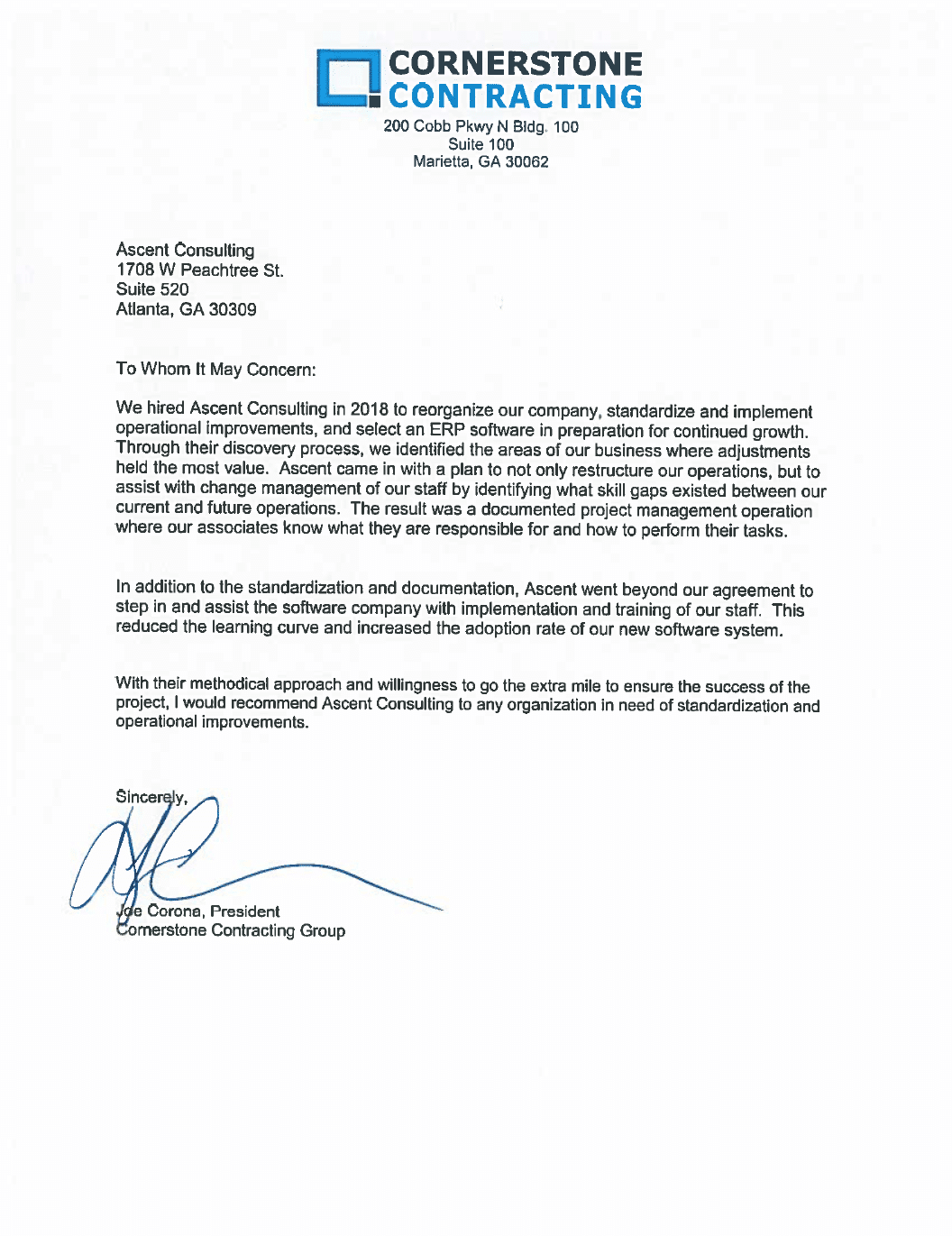
“With their methodical approach and willingness to go the extra mile to ensure the success of the project, I would recommend Ascent Consulting to any organization in need of standardization and operational improvements.”
Joe Corona
President
Cornerstone Contracting Group
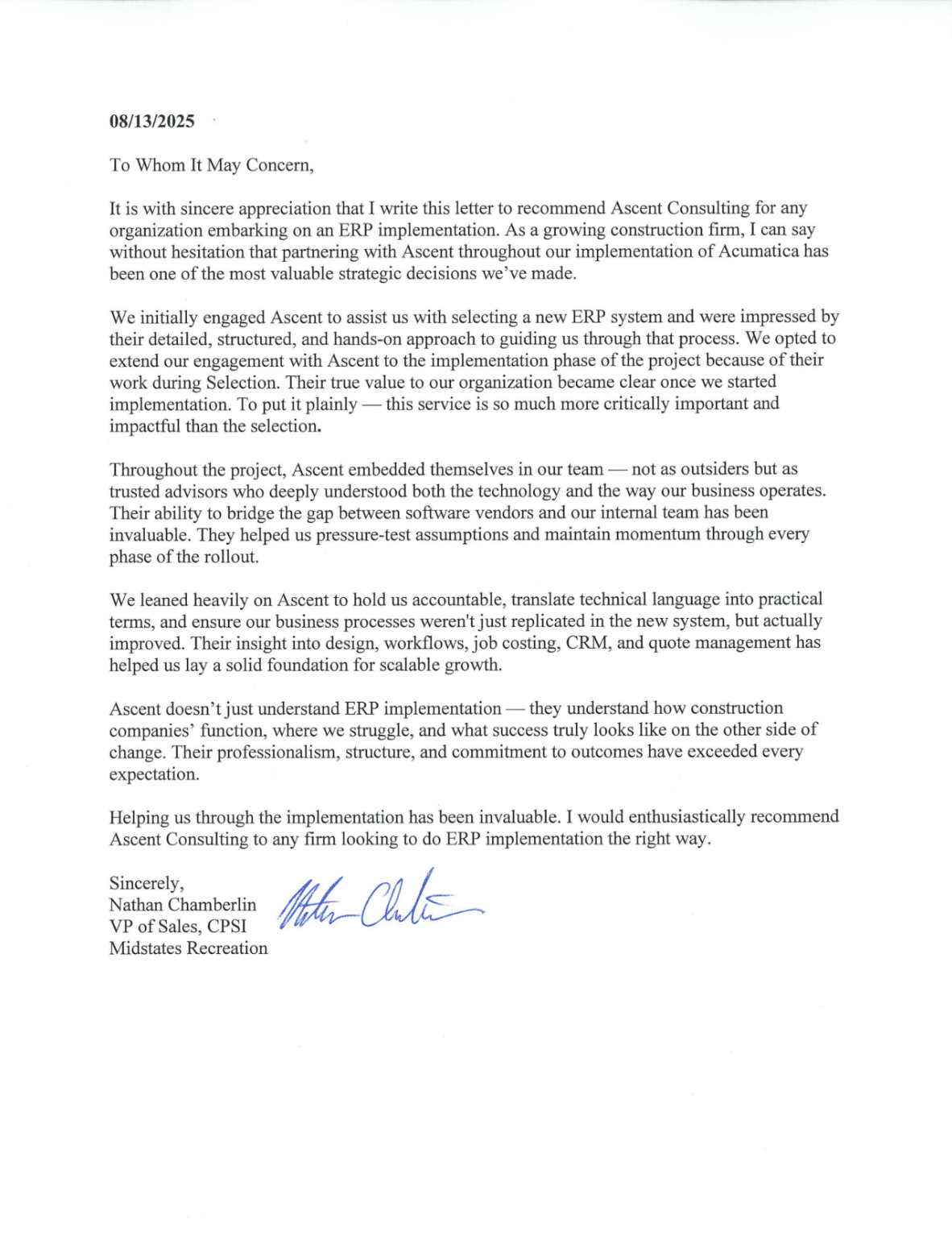
"Ascent doesn't just understand ERP implementation — they understand how construction companies function, where we struggle, and what success truly looks like on the other side of change."
Nathan Chamberlin
VP of Sales
Midstates Recreation
Get PMO consulting & coordination from people who have been in your position.
What we do
PMO Is Part of a Larger Strategy
A technology change rarely stays contained to one system. PMO works better when evaluating related aspects of your business that need to change too:
Construction Technology Audit & Integration
Construction Technology Audit & Integration
Not Sure If You Need a PMO?
You probably do not need a PMO for every software implementation. But the need increases quickly when:
-
Multiple systems are changing at the same time
-
Several software vendors or implementation partners are involved
-
Your ERP and project management systems must integrate
-
Significant historical data needs to migrate
-
Multiple departments are affected
-
Your internal team lacks implementation capacity
-
You are consolidating companies or technology environments
-
Business processes need to change along with the software
-
The implementation has stalled or gone off track
-
Leadership cannot get a clear picture of project status
-
Nobody inside the company has responsibility for the overall outcome
If you are preparing for a major technology change, we can help you determine what level of oversight makes sense.
Frequently Asked Questions (FAQ)
01. What does a PMO consultant for construction do?
A PMO provides leadership and oversight for the entire technology initiative.
Ascent manages the integrated implementation plan, governance structure, vendor coordination, internal workstreams, dependencies, decisions, risks, stakeholder communication, readiness, and overall progress. Our job is to make sure all of the individual pieces come together into a successful business outcome.
02. Is PMO the same thing as ERP consulting?
ERP implementation advisory is one type of PMO engagement. PMO is broader.
A PMO engagement may include an ERP, Procore, payroll, estimating, CRM, middleware, data migration, analytics, or several systems simultaneously. In those situations, PMO provides oversight across the entire technology change rather than focusing on one application.
03. Why can't our software vendor manage the project?
They can—and should—manage implementation of their portion of the project. But their responsibility generally begins and ends with their software. An ERP VAR is not responsible for how your project managers use Procore. Procore is not responsible for your payroll configuration. Your integration developer is not responsible for organizational adoption.
Ascent manages the spaces between those scopes and represents your interests across the entire initiative.
04. How is Ascent different from the software vendor or VAR?
We work for you. Ascent does not sell the software and does not receive compensation from the software company. That allows us to evaluate decisions based on what is best for your company rather than what makes an individual product easiest to implement. We also bring a construction-wide perspective across project management, accounting, operations, technology, workflows, and integrations that individual software providers typically do not.
05. What does Ascent do day-to-day during a PMO engagement?
Depending on the project, that can include:
- Leading project and steering committee meetings
- Maintaining the integrated implementation plan
- Tracking actions and decisions to closure
- Coordinating vendors and internal teams
- Managing risks and dependencies
- Reviewing configurations and workflows
- Supporting process and policy decisions
- Coordinating data migration
- Managing testing and validation
- Monitoring stage-gate readiness
- Supporting stakeholder communication
- Coordinating training and adoption
- Managing cutover planning
- Reporting status to executives
- Supporting post-go-live stabilization
The exact activities change as the program moves through each phase.
06. Who makes the final business decisions in a PMO project?
You do. Ascent provides the information, analysis, alternatives, recommendations, and program structure necessary to make informed decisions. Your leadership retains ownership of business policy, governance, and final go/no-go decisions. We facilitate and advise. We do not impose.
07. When should Ascent become involved?
Ideally, before the implementation begins. That allows us to help establish the governance structure, roadmap, resource plan, data strategy, workflows, and implementation sequence before major commitments are made. But we are also frequently brought into projects already underway when implementation has stalled, integrations are not working, the scope has expanded, or leadership realizes the project needs independent oversight.
08. What happens to historical data during a migration?
That depends on the systems involved, your active project portfolio, reporting requirements, and how much historical information the business needs.
One of the earliest PMO decisions is determining what must migrate, what should remain accessible in a legacy environment, how far back transactional history should go, and how active projects will transition. There is rarely a universal “move everything” answer. The right strategy balances operational needs, reporting requirements, effort, risk, and cost.
09. How long does a PMO engagement last?
The duration depends on the complexity of the technology change. A focused implementation may take several months. A complex ERP migration, multi-system integration, or multi-company consolidation may run a year or longer.
Ascent helps establish a realistic implementation schedule and then manages the program against that plan. The goal is not to move as quickly as the software company wants. The goal is to move as quickly as the business can responsibly support.
10. Does Ascent stay involved after go-live?
Yes, when the engagement requires it. A successful go-live proves that the system can turn on. Stabilization proves that the company can actually operate with it.
We typically plan for post-go-live validation, issue resolution, workflow refinement, and the first critical operating cycles so problems are addressed before the project is considered complete.
Build a Technology Environment That Actually Works
Your team knows how to build projects and run a construction company. They should not have to become experts in managing ERP vendors, software integrations, data migrations, and digital transformation at the same time.
Ascent provides the leadership, experience, and accountability to guide the change from strategy through successful adoption.We build better construction companies.